- Future//Proof
- Posts
- 😱 13-year-old student from Hyderabad creates AI which thinks like humans
😱 13-year-old student from Hyderabad creates AI which thinks like humans
A 13-year-old just out-built Silicon Valley + AI regulation war heats up + Meta's WhatsApp play to dethrone ChatGPT + your weekly tool, quiz, and more inside 🔥

Avinash Mada
March 26, 2026
In partnership with

Welcome to the Future//Proof 🚀
👋 Hello , the AI Enthusiast.
In this week’s edition, we brought AI updates backed by high-quality research and data to give you deeper insights. You'll find the Top AI Breakthrough of the Week, a featured AI tool with a mini-tutorial, learning resources to help you master these tools, the top 3 AI news stories, and more.
Our goal is to help you improve your knowledge and stay ahead in the rapidly evolving AI landscape. You can submit your questions, queries, thoughts, opinions or anything regarding AI as a reply to this email and we'll feature and address them in our next newsletter.
🚀 Now Let’s dive in and explore the new AI Insights together!
⌛ Read Time: 5m:43s
Here’s how I use Attio to run my day.
Attio is the AI CRM with conversational AI built directly into your workspace. Every morning, Ask Attio handles my prep:
Surfaces insights from calls and conversations across my entire CRM
Update records and create tasks without manual entry
Answers questions about deals, accounts, and customer signals that used to take hours to find
All in seconds. No searching, no switching tabs, no manual updates.
Ready to scale faster?

An in-depth look at a major AI development, its industry impact, how it could affect your career, and a bold future prediction.
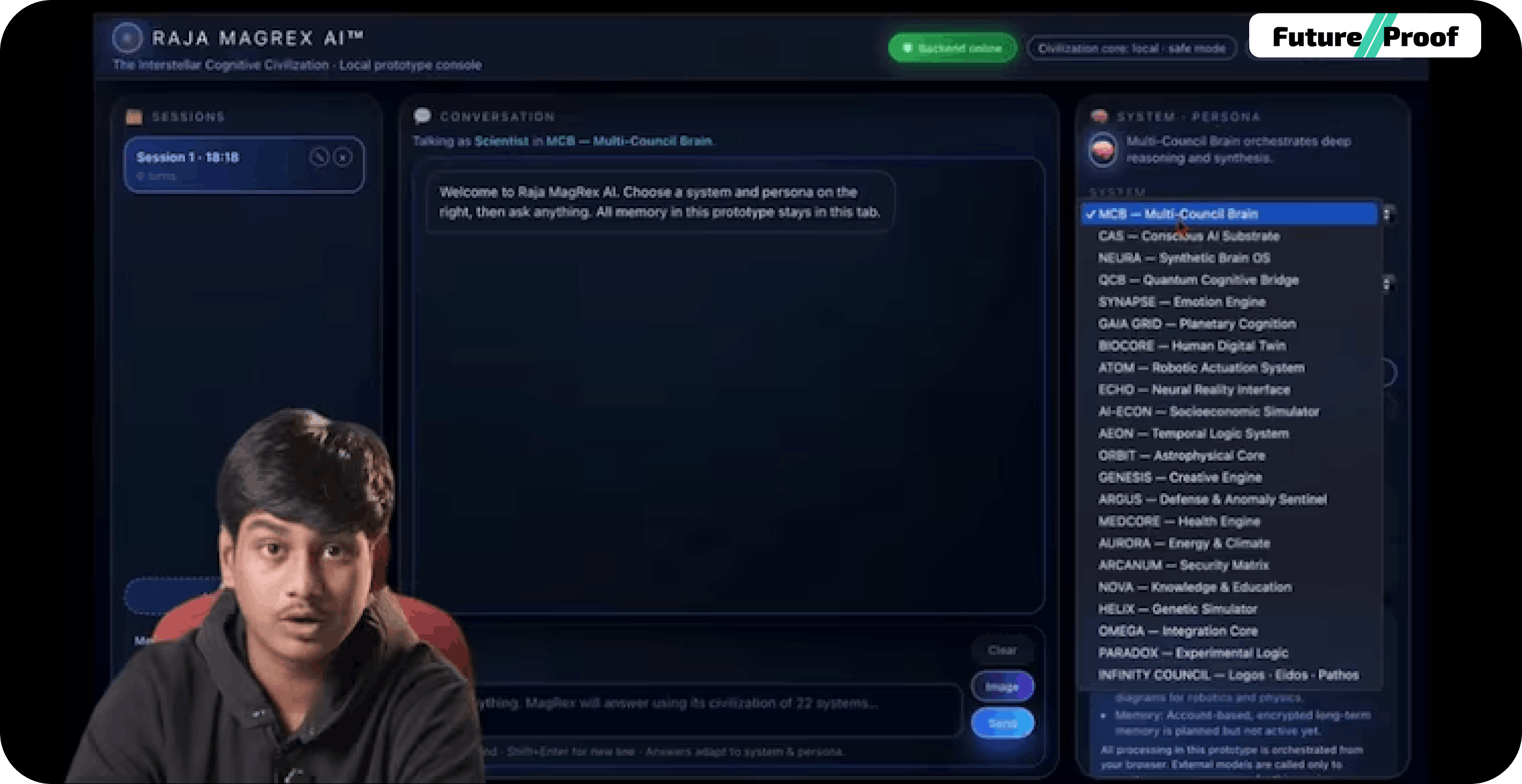
Raja Dharma Tej Maddala, a Grade 7 student at Oakridge International School, Gachibowli, has developed Raja MagRex AI™ an original multi-system AI framework recognised as an innovation initiative by India's DPIIT. The architecture is built around a concept he terms "Artificial Civilisation Intelligence," inspired by how multi-disciplinary human societies collaborate to resolve complex challenges. At its core sits NEURA, a coordination engine that routes incoming problems to specialised cognitive modules covering logic, contextual reasoning, analysis, and creative exploration. This is not a chatbot or a wrapper product. It is an attempt to architect distributed machine reasoning from first principles by a 13-year-old. The DPIIT recognition validates it as an original innovation, not a school project. With Version 1 heading toward real-world testing, the framework targets research, policy analysis, and complex decision-support; domains where single-model AI consistently underperforms.
Potential Impact
This architecture challenges the dominant single-model paradigm by proving that coordinated, specialised AI modules can tackle problems that monolithic LLMs handle poorly. Three high-leverage applications stand out: urban policy planning simultaneously analysing pollution sources, traffic patterns, weather, and regulatory options to surface balanced interventions; adaptive education breaking scientific problems into layered reasoning paths for students; and enterprise decision analysis stress-testing complex business or research problems across multiple reasoning lenses at once. The NEURA orchestration model, if scaled, could become a foundational pattern for next-generation agentic AI systems globally.
Implications for People/Careers
This story signals a structural shift in who builds AI and when they start. A 13-year-old architecting a government-recognised AI framework means the entry barrier for meaningful AI innovation is no longer age, institution, or capital — it is conceptual clarity and determination. For mid-career professionals still treating AI as a productivity add-on, this is a wake-up call. The next wave of AI builders will not emerge from legacy tech pipelines; they will emerge from classrooms. Roles built on executing processes — analysis, research synthesis, decision documentation — face mounting irrelevance. Those who understand AI architecture, orchestration logic, and system design at a conceptual level will dominate the next decade's talent premium.
Our Future//Take
India is no longer just an AI consumer or services exporter — it is producing original architectural thinking at the school level. Raja MagRex AI represents something larger: the democratisation of AI system design as an intellectual discipline, not a corporate monopoly. What you should do now — study multi-agent frameworks (AutoGen, CrewAI, LangGraph) and understand how orchestration logic works; that is where the next platform layer is being built. For India's startup and education ecosystem, the implication is urgent: fund young innovators earlier, teach systems thinking in middle school, and stop gatekeeping innovation behind degrees. The next foundational AI company may already be running out of a Gachibowli bedroom. Here's your ₹25,000 AI Gift for FREE 🎁

Quick summaries of this week's top AI news, their relevance to your career, and our expert opinions.
Sanders and AOC have introduced companion legislation in the Senate and House to impose an immediate moratorium on data center construction for any facility with peak power loads exceeding 20 megawatts, which covers virtually every hyperscale AI infrastructure project in development. The halt stays in place until Congress enacts comprehensive AI regulation. The bill goes further: it demands government review and certification of AI models before public release, protections against AI-driven job displacement, mandatory union labour in data center construction, environmental impact limits, and a ban on exporting advanced chips to countries without equivalent regulations. A March 2026 Pew Research poll shows only 10% of Americans say their excitement about AI outweighs their concern. This is not a fringe position anymore. It is a legislative opening bid backed by public sentiment, and it names Altman, Amodei, Hassabis, and Hinton as justification.
Why It Matters to You
If you are building on top of AI infrastructure, whether you are scaling a product, raising on an AI thesis, or planning compute-heavy deployments, the regulatory floor just moved. This bill likely won't pass in its current form, but it sets the negotiating baseline. Every provision in it becomes a potential compromise in future regulation. Pre-release model certification alone could reshape how fast labs ship and how quickly you can build on new capabilities. Watch this bill closely. The language in it today is the regulation you will be operating under in two to three years.
Our Take
This is Washington's first credible attempt to treat AI infrastructure the same way it treats nuclear or pharmaceutical development, with mandatory pre-clearance before deployment. It won't pass clean, but it doesn't need to. Its real function is to anchor the regulatory debate and force the industry to negotiate. The chip export ban provision is the sleeper clause. It would isolate the US AI supply chain in ways that make current export controls look mild. Your move: get familiar with AI governance frameworks now, build compliance flexibility into your product architecture, and start treating regulation as a product constraint, not an afterthought. The founders who build with this in mind will be the ones still standing when the rules land. 👉 Do Not Delay Anymore - Master AI Before Its Too Late.
At the White House's "Fostering the Future Together" summit, attended by 45 nations, Melania Trump walked a Figure AI humanoid robot down a red carpet and publicly envisioned a world where a robot named Plato teaches every child, personalised and available around the clock. This is not a concept video. Figure AI had a physical robot on stage, speaking. The same week, the Trump administration named Zuckerberg, Ellison, and Huang to a tech advisory council. Secretary of Education Linda McMahon visited Alpha School, a private AI-first school chain that charges $55,000 per child annually and already operates in Chicago. McMahon is simultaneously dismantling the Department of Education she runs. The signal is clear: the US government is actively redirecting education funding, attention, and credibility toward private, AI-driven alternatives. The edtech market just got a White House stage.
Why It Matters to You
If you build in edtech, training, or personalised learning, the distribution ceiling just lifted. White House-level visibility for AI education is a category legitimisation event. Parents, school boards, and investors who were on the fence now have political cover to move. If you are a founder in this space, the question is not whether AI education will scale but whether you are positioned before the capital wave hits. If you are a professional in traditional education or corporate L&D, this signals where budget and attention will flow next. Get ahead of it or get displaced by whoever does.
Our Take
When a sitting First Lady puts a humanoid robot on a White House red carpet and 45 countries show up to watch, it stops being a vision statement and starts being policy direction. The simultaneous dismantling of the Education Department is not a coincidence. It clears the institutional space for private, tech-driven alternatives to fill. Alpha School at $55,000 per child is today's proof of concept. Tomorrow's version will be cheaper, faster, and government-adjacent. If you are building in edtech or AI tutoring, move now. The window between "visionary idea" and "crowded market" in this space just got significantly shorter.
WhatsApp, with over 3 billion active users, has expanded its Writing Help feature, originally launched in August 2025, to now generate contextual AI reply suggestions based on the actual content of your conversations. Beyond message drafting, the update bundles Meta AI photo editing directly inside chats, lets users delete large files without wiping full conversations, enables dual account login on iOS for the first time, and adds cross-platform iOS to Android chat history migration. Meta's strategy is explicit: keep users inside WhatsApp for tasks they currently leave the app to complete elsewhere, particularly ChatGPT. Every new feature reduces a reason to switch context. WhatsApp claims Writing Help chats remain private. The update rolls out globally to all users starting today, no subscription required, no paywall.
Why It Matters to You
If you run a business, manage a team, or handle high-volume client communication on WhatsApp, this changes your workflow immediately. AI-drafted replies based on conversation context means faster turnaround on routine messages without switching to another tool. For creators and solopreneurs managing customer conversations at scale, this is a built-in assistant that requires zero setup. The bigger strategic point: Meta is training users to trust AI inside their most personal communication channel. If that trust holds, Meta AI becomes the default assistant for the majority of the world's mobile users, not OpenAI, not Google.
Our Take
This is not a feature drop. This is Meta planting a flag in the AI assistant wars using distribution that no competitor can match. WhatsApp's 3 billion users represent the largest captive audience for any AI rollout in history, and Meta just put Meta AI inside the most intimate digital space people use daily. ChatGPT has a product advantage today. Meta has a reach advantage that compounds every time someone uses Writing Help instead of opening a separate app. Watch for adoption rates in markets like India, Brazil, and Southeast Asia where WhatsApp is the primary internet communication layer. That is where this battle will be decided, and Meta is already there. AI Mastery for FREE (Sign up Now).

Discover a comprehensive guide to an AI tool, exploring its features, practical use cases, and learning resources to help you master it.

🗣️ Delphi AI
Delphi AI is an innovative platform that enables experts, influencers, and professionals to create AI-driven digital clones of themselves, facilitating scalable and personalized interactions with their audience.
⭐ Top Features
Digital Cloning Technology: Allows users to create AI replicas by uploading content such as videos, podcasts, and documents, capturing their unique knowledge and communication style.
Natural Language Processing: Employs advanced NLP to ensure interactions with digital clones are coherent and contextually relevant, enhancing user engagement.
Expert Marketplace: Provides a platform where users can access a variety of digital clones across different domains, offering personalized advice and insights from various experts.
Predictive Analytics: Offers tools for forecasting business outcomes and understanding customer intent, aiding in the development of hyper-personalized experiences.
Monetization and Analytics: Enables experts to monetize their digital clones and provides analytics to understand audience engagement, refining content strategies effectively.

A curated list of noteworthy AI tools and their key details to help you stay ahead in your field.

PreCheck.ai is an AI-powered platform offering facial recognition and identity verification services. It enables users to monitor online images, protect personal privacy, and prevent fraud with high accuracy.

AI Headshot Generator is a tool that transforms selfies into professional headshots without the need for a photoshoot. By uploading at least four high-quality selfies, users can receive polished headshots in approximately 30 minutes, suitable for various professional uses.

Go Legal AI is a comprehensive legal tech platform designed to simplify legal tasks for businesses, freelancers, and individuals. Powered by advanced AI, it offers over 5,000 customizable legal templates, AI-assisted document drafting and editing, and automated compliance tracking with smart reminders.

TalkText is an AI-powered dictation tool for Mac that refines spoken language into polished text. It removes filler words and corrects mistakes, allowing users to dictate naturally while producing clear and professional written content.

A quick poll to help you recollect and engage with key points from the newsletter.
What is the name of the AI framework developed by 13-year-old Raja Dharma Tej Maddala? |

Share your feedback on today's edition to help us improve and better meet your needs.
How was Today’s Edition? |
Share our Newsletter ⏩
Enjoying our insights on the latest AI breakthroughs? Don’t keep it to yourself! Share this newsletter with friends and colleagues who are passionate about technology and AI innovation.
If you haven’t subscribed yet, make sure to subscribe here to stay updated with cutting-edge AI news, tools, and tutorials delivered straight to your inbox!
Ask Us Anything AI ❓
Got questions? We've got answers!
Submit your questions, queries, thoughts, opinions or anything regarding AI and we'll feature and address them in our next newsletter. Your curiosity drives our content!
👇 Reply to this email with your questions, and we'll answer them in our next edition!👇