- Future//Proof
- Posts
- 🤯 Tough days ahead for OpenAI as Gemini dominates AI market
🤯 Tough days ahead for OpenAI as Gemini dominates AI market
OpenAI is fighting for its life as Google pushes Gemini to billions via Android 👇

Avinash Mada
November 27, 2025
In partnership with

Welcome to the Future//Proof 🚀
👋 Hello , the AI Enthusiast.
In this week’s edition, we brought AI updates backed by high-quality research and data to give you deeper insights. You'll find the Top AI Breakthrough of the Week, a featured AI tool with a mini-tutorial, learning resources to help you master these tools, the top 3 AI news stories, and more.
Our goal is to help you improve your knowledge and stay ahead in the rapidly evolving AI landscape. You can submit your questions, queries, thoughts, opinions or anything regarding AI as a reply to this email and we'll feature and address them in our next newsletter.
🚀 Now Let’s dive in and explore the new AI Insights together!
⌛ Read Time: 6m:03s
Shoppers are adding to cart for the holidays

Over the next year, Roku predicts that 100% of the streaming audience will see ads. For growth marketers in 2026, CTV will remain an important “safe space” as AI creates widespread disruption in the search and social channels. Plus, easier access to self-serve CTV ad buying tools and targeting options will lead to a surge in locally-targeted streaming campaigns.
Read our guide to find out why growth marketers should make sure CTV is part of their 2026 media mix.

An in-depth look at a major AI development, its industry impact, how it could affect your career, and a bold future prediction.
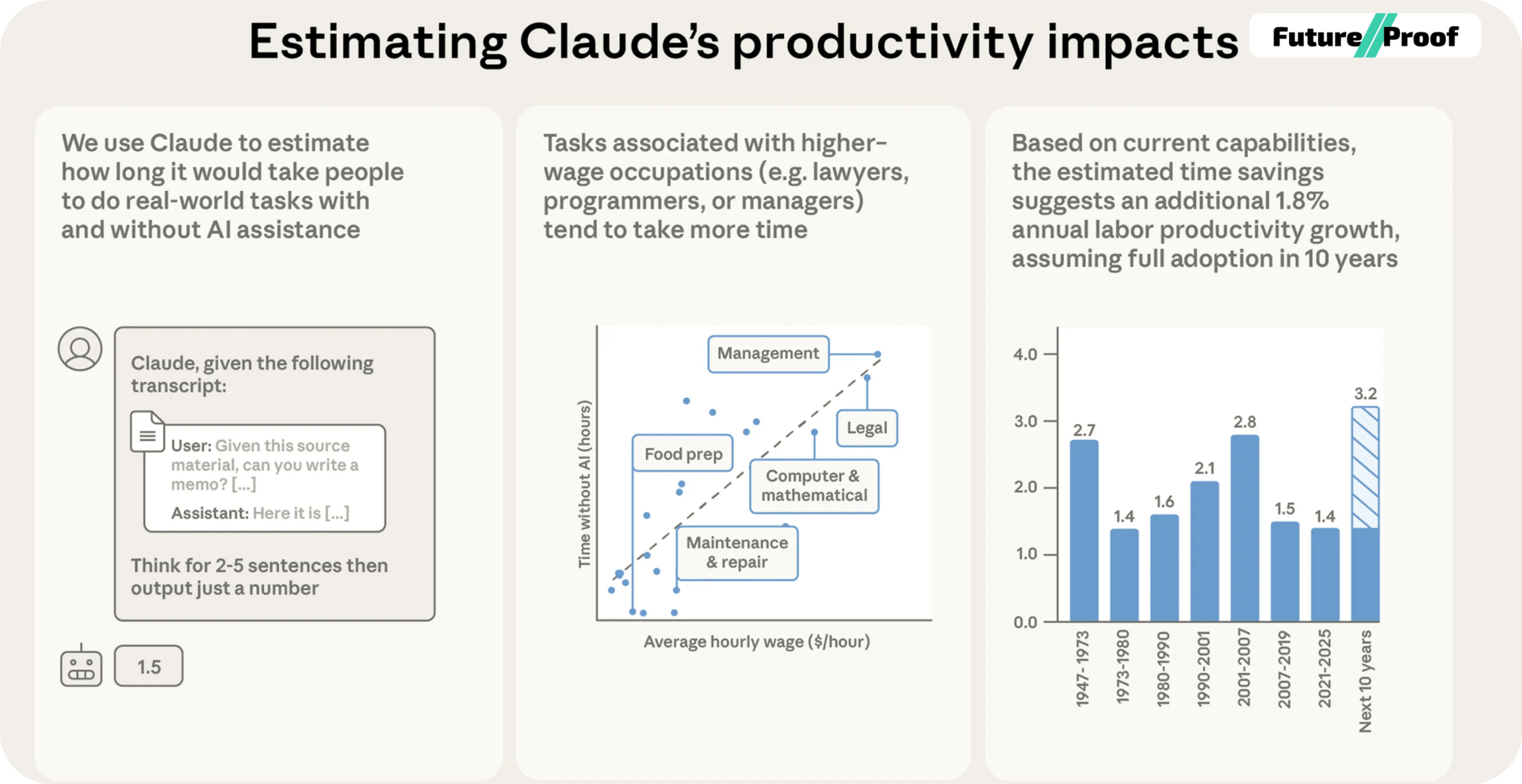
Anthropic study reveals current AI could nearly double US labor productivity growth
Anthropic has released a landmark economic analysis based on 100,000 anonymized Claude.ai conversations, revealing that current-generation AI cuts task completion time by an average of 80%. The study, which benchmarks against JIRA tickets and O*NET wage data, estimates that universal adoption of today's models could drive US labor productivity growth by 1.8% annually, effectively doubling the national run rate seen since 2019. This isn't theoretical forecasting; it’s an empirical look at how AI is already compressing hours of work into minutes. Specifically, complex tasks in software development, legal, and management that typically take 1.4 hours are being executed at a fraction of the cost. The data signals a massive efficiency unlock for information-heavy sectors, positioning AI not just as a tool, but as a macroeconomic lever comparable to the tech boom of the late 1990s.
Potential Impact
Software & Engineering: Developers are seeing the highest leverage, with massive acceleration in coding, testing, and documentation, freeing time for architecture and system design.
Corporate Strategy & Legal: High-value tasks like contract review, strategic planning, and report generation (often costing $50+ per hour in human labor) are being automated rapidly.
Healthcare Administration: Administrative and assistance tasks are seeing up to 90% speed improvements, potentially alleviating burnout in non-clinical workflows. This shifts the focus from "doing the work" to "directing the outcome," effectively turning individual contributors into managers of AI agents.
Implications for People/Careers
Mid-Level Knowledge Workers: The "middleman" function of synthesizing information is vanishing. If your value is purely execution (writing code, drafting emails, summarizing reports), you are at immediate risk.
Shift to Orchestration: Value flows to those who can define problems and validate AI outputs. The bottleneck is no longer production, but supervision and implementation.
Physical & Interpersonal Roles: Jobs requiring physical presence (construction, healthcare delivery) or complex human coordination remain safe "bottlenecks" where AI has little reach, potentially increasing their relative economic value as digital costs plummet.
Our Future//Take
This data confirms that we are in the early stages of a productivity supercycle. The 1.8% growth projection is likely a conservative floor, as it assumes constant model capabilities—yet we know models are improving exponentially. The immediate play is to identify the "1.4-hour tasks" in your workflow and automate them now. Organizations that fail to integrate these gains will face an insurmountable cost disadvantage within 24 months. We are moving toward an economy where output is cheap, but judgment is expensive. Start optimizing for judgment. Here's your ₹25,000 AI Gift for FREE 🎁

Quick summaries of this week's top AI news, their relevance to your career, and our expert opinions.
OpenAI CEO Sam Altman has issued a stark internal warning to employees, predicting "rough months" ahead as the company faces its most significant competitive threat to date. The memo highlights a shifting power dynamic: while OpenAI relies on users intentionally seeking out ChatGPT, Google is weaponizing its massive ecosystem to push Gemini 3.0 to billions of users through Search, Workspace, and Android. Altman acknowledged that Google’s "full-stack" advantage and financial scale are creating headwinds for standalone AI companies. He noted that while rivals like Anthropic and Google are closing the capability gap, OpenAI must simultaneously operate as the world’s best research lab, infrastructure provider, and product company to survive. The directive is clear: the "easy" growth phase is over, and the company must now execute flawlessly against competitors with deeper pockets and broader distribution channels.
Why It Matters to You
For founders and operators, this signals the end of the "one model to rule them all" era. The playing field is fracturing. You can no longer default to OpenAI simply because they moved first. Google’s aggressive integration means your average user will likely adopt AI through existing workflows (Docs, Android) rather than a standalone app. If you are building AI products, you must decide: do you align with the "destination" (ChatGPT) or the "utility" (Google)? The moat is no longer just model intelligence—it’s distribution and workflow integration.
Our Take
This was inevitable. OpenAI’s early lead was defined by magic, but the next phase is defined by utility and friction. Google isn't winning because Gemini is strictly "smarter"—they are winning because they are removing the friction of adoption. We predict a brutal 12-month period where OpenAI is forced to ship features faster than is comfortable to stay relevant. For the market, this is excellent news; for OpenAI, it is an existential test of their ability to transition from a research lab to a product powerhouse without breaking. Expect aggressive price wars and rapid-fire model releases. 👉 Do Not Delay Anymore - Master AI Before Its Too Late.
“More companies than ideas": Sutskever warns the market is saturated with capital but starved for genuine breakthroughs.
Ilya Sutskever, the architect of the modern generative AI boom, argues the industry has left the "Age of Scaling"—where adding compute guaranteed linear gains and entered the "Age of Research," where progress requires novel qualitative breakthroughs. He highlights a critical "jaggedness" in state-of-the-art models: they crush advanced benchmarks (like competitive coding) but fail at basic iterative tasks (like fixing a bug without introducing a new one). This suggests that current Reinforcement Learning (RL) methods are creating brittle, narrow optimizations rather than true generalization. His new venture, Safe Superintelligence (SSI), is explicitly rejecting the industry’s product-obsessed roadmap to focus entirely on a "straight shot" to superintelligence. Sutskever is betting that the next leap won't come from merely expanding data clusters, but from solving the fundamental "it" factor of reasoning and safety that pre-training currently misses.
Why It Matters to You
The playbook for building in AI just changed. The "scale is all you need" narrative is officially hitting diminishing returns. Sutskever’s pivot signals that the next trillion dollars of value won't be unlocked by simply hoarding H100s, but by architectural innovations that solve reliability and reasoning. For founders and strategists, this means the era of "easy wrapper" growth is ending; value now shifts to those who can bridge the gap between "eval smart" and "production useful." Stop expecting the next model update to magically solve your reliability issues—you need to engineer novel solutions around them now.
Our Take
Ilya has a terrifyingly good track record of predicting the next five years (AlexNet, GPT-3). If he is pivoting to pure research while the rest of the market aggressively commercializes current tech, he sees a wall the market is ignoring. We predict a massive shakeout of "idea-poor, execution-rich" AI startups that are relying on model scaling to fix their product flaws. The winners of the next cycle will be those who treat AI as a reasoning architecture problem, not just a data scale problem. Expect capital to flee generic scaling plays and flood into "deep tech" labs demonstrating novel approaches to generalization.
PhonePe has officially integrated OpenAI’s ChatGPT into its ecosystem, signaling a massive pivot from a transactional wallet to an intelligent super app. This collaboration brings generative AI to millions of Indian users across the PhonePe consumer app, business platforms, and Indus Appstore. The integration targets high-intent categories like travel planning, shopping, and interactive discovery, allowing users to move from searching to solving within a single interface. Coming just a month after PhonePe’s confidential IPO filing, this move is a strategic play to deepen user retention and increase session times. By layering AI over its payment rails, PhonePe is aiming to own the decision-making layer of commerce, effectively challenging competitors by making the payment experience conversational and advisory rather than just functional.
Why It Matters to You
This marks the death of the static transaction interface. For founders and product strategists, the lesson is urgent: your app can no longer just be a utility; it must be an agent. PhonePe is proving that conversational AI is the new UI for commerce. If you are building in fintech or consumer tech, you must stop viewing AI as a support bot and start building it as a concierge that drives revenue. The shift is from users tapping buttons to users stating intent. If your product cannot understand and execute complex intent, you will lose to platforms that can.
Our Take
This signals the beginning of "Agentic Fintech" where the AI manages the entire purchase lifecycle rather than just the payment. We predict this is a defensive moat being dug to protect against churn before a public listing. Purely transactional apps will eventually become obsolete, replaced by interfaces that plan and execute for the user. Your immediate move should be to audit your user flows for friction that an LLM could remove. Don't just build a chat wrapper; build deep vertical integrations where the AI executes the trade, books the flight, or orders the stock. ⚡AI Mastery for FREE (Sign up Now).

Discover a comprehensive guide to an AI tool, exploring its features, practical use cases, and learning resources to help you master it.

Stitch is an AI-powered design and development tool from Google Labs that transforms natural language prompts, sketches, and screenshots into high-fidelity user interfaces and production-ready frontend code using advanced Gemini models.
⭐ Top Features
Text-to-UI Generation: Instantly converts plain English descriptions into fully rendered mobile or web interface designs, allowing for rapid prototyping without manual layout work.
Sketch-to-Code Transformation: "Experimental Mode" enables users to upload hand-drawn wireframes, whiteboard sketches, or screenshots and automatically converts them into functional digital designs.
Production-Ready Code Export: Generates clean, usable HTML, CSS, and Tailwind code that developers can copy-paste directly into their projects, bridging the gap between design and development.
Seamless Figma Integration: Features a "Copy to Figma" button that exports designs with full Auto Layout, layers, and nesting preserved, making it easy for designers to refine outputs.
Iterative Refinement: Allows users to modify specific screen elements, swap themes, or adjust layouts conversationally through follow-up prompts without regenerating the entire project.
Multi-Variant Exploration: Automatically generates multiple design options for every prompt, helping teams explore different aesthetic directions and layout possibilities in seconds.

A curated list of noteworthy AI tools and their key details to help you stay ahead in your field.

Podwise is a premier knowledge management tool for podcast listeners that uses AI to transcribe episodes, generate summaries, and create mind maps, helping users extract and organize key insights efficiently.

Tellers is an interactive storytelling platform that allows users to engage in immersive roleplay by chatting with customizable, lifelike AI characters, facilitating dynamic and uncensored narrative experiences.

Recraft is a generative AI design tool built for professionals that creates high-quality vector art, icons, and 3D illustrations, allowing users to generate editable assets while maintaining strict brand and style consistency.

Sivi is a generative design assistant that instantly transforms text prompts into fully editable, multi-layered graphic designs, enabling marketers to create on-brand ads, banners, and social media content in seconds.

A quick poll to help you recollect and engage with key points from the newsletter.
What is the estimated annual US labor productivity growth attributable to the universal adoption of current-generation AI, according to Anthropic's study? |

Share your feedback on today's edition to help us improve and better meet your needs.
How was Today’s Edition? |
Share our Newsletter ⏩
Enjoying our insights on the latest AI breakthroughs? Don’t keep it to yourself! Share this newsletter with friends and colleagues who are passionate about technology and AI innovation.
If you haven’t subscribed yet, make sure to subscribe here to stay updated with cutting-edge AI news, tools, and tutorials delivered straight to your inbox!
Ask Us Anything AI ❓
Got questions? We've got answers!
Submit your questions, queries, thoughts, opinions or anything regarding AI and we'll feature and address them in our next newsletter. Your curiosity drives our content!
👇 Reply to this email with your questions, and we'll answer them in our next edition!👇